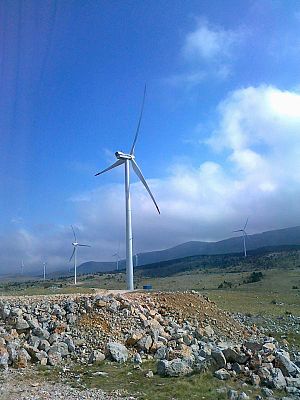
Wind power has become one of the main pillars of Poland’s energy transition, helping the country reduce its heavy dependence on coal.
Key facts about wind energy in Poland:
- Poland had around 10.5–11 GW of installed wind capacity by 2025, making it one of the largest wind markets in Central and Eastern Europe.
- Wind power supplies roughly 14% of Poland’s electricity generation, though this varies depending on weather conditions.
- Most current wind generation is onshore wind, especially in northern and western Poland.
- Poland is now rapidly developing offshore wind farms in the Baltic Sea, which are expected to become a major energy source in the late 2020s.
Why wind power matters in Poland
Historically, Poland relied heavily on coal for electricity. Wind and solar are now changing that:
- Renewable energy exceeded 50% of installed power capacity for the first time at the end of 2025.
- Wind was one of the earliest large-scale renewables in Poland and remains critical for decarbonization.
- Offshore wind is viewed as especially important because the Baltic Sea has strong and consistent wind conditions.
Offshore wind expansion
Several large offshore projects are underway:
- Companies including Equinor, Orlen, PGE, Ørsted, and Polenergia are developing projects along the Baltic coast.
- A major project approved in 2025 includes 1.44 GW of offshore capacity and is expected to begin generation around 2027–2028.
- Poland aims for about 6 GW of offshore wind by 2030, with much larger long-term potential estimated at up to 33 GW.
Challenges
Wind development in Poland has faced several obstacles:
- Strict setback rules previously limited where turbines could be built near homes.
- Grid infrastructure needs major upgrades to handle more renewable power.
- Coal still accounts for over half of electricity generation, so the transition is ongoing.
Recent policy changes
The Polish government has been moving to ease restrictions on onshore wind farms:
- New legislation aims to liberalize siting rules for turbines.
- The government says expanded wind deployment is essential for meeting EU climate goals and reducing electricity costs.
Overall, Poland is shifting from being one of Europe’s most coal-dependent countries toward a more diversified energy mix where wind — especially offshore wind — plays a central role.